A storage facility investment can mean four different things, and the gap between them is wider than most of what's written on the subject suggests. Buying shares of Public Storage is not the same as buying a 40,000 square foot facility outside Tyler, TX. Neither one involves writing a $50,000 check into someone else's deal and never touching the operations.
All three produce something called a self-storage return. However, they produce it through completely different mechanisms, carry different risks, and suit different people.
This guide walks through what a facility actually is as a business, how it makes money, the four ways to own a piece of one, what the returns look like when the plan works, and what goes wrong when it doesn't.
I spend my days underwriting these. My partner Phillip and I have run hundreds of facilities through our model across Texas, Arkansas, Tennessee, and the Carolinas, and passed on nearly all of them. So this is the operator's version: what the numbers look like from the seat of the person who has to make them work.
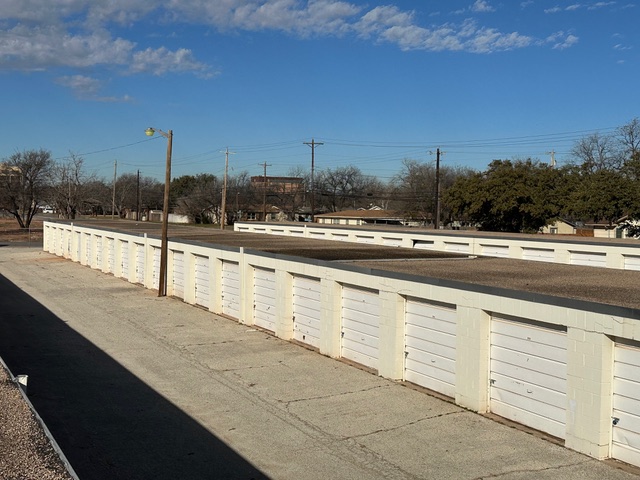
Strip away the investment framing and a self-storage facility is a few acres of land with metal buildings on it, divided into somewhere between 50 and 2,000 units, rented by the month.
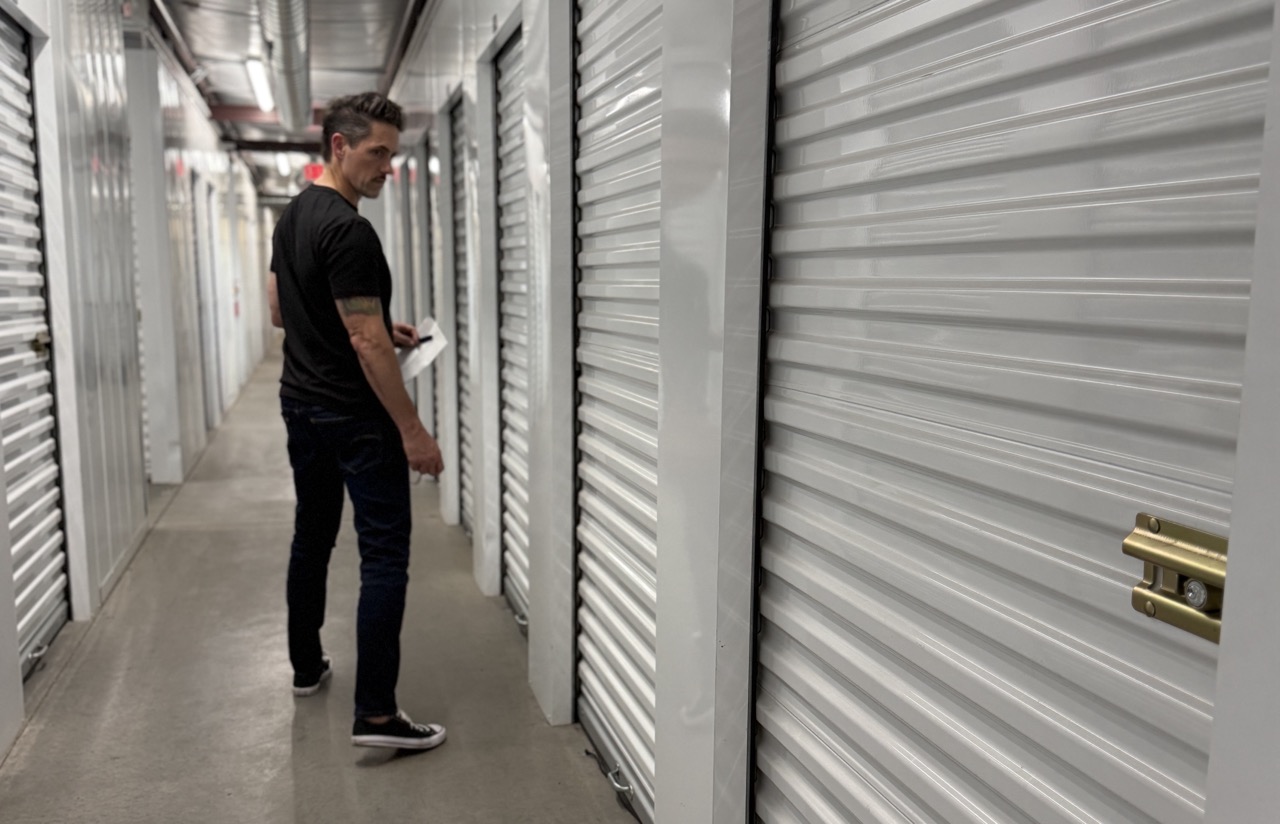
The unit mix usually runs from a 5x10 (a closet, roughly) up to a 10x30 (which fits a car). Most facilities in secondary markets are drive-up, single story, non-climate-controlled. Climate control units command higher rates but cost more to build and operate. Many facilities also rent parking spaces for RVs and boats, which is often the most overlooked revenue line on the property.
The tenants fall into two main groups. Households in transition make up most of them: someone moving, downsizing, settling a divorce, or clearing out a parent's house. The second group is small businesses. Contractors storing tools and materials, e-commerce sellers holding inventory, landscapers parking trailers. Business tenants tend to stay longer and complain less. There are others (military families mid-move, people between houses, the occasional collector) but households in transition and small businesses are the primary driver of demand.
What separates this from a landlord business is the lease. Storage tenants sign up on a month-to-month lease. There is nothing like a 12-month residential lease or a five-year commercial term, and no tenant improvement budget (meaning the money a commercial landlord fronts to build out walls, flooring, lighting, HVAC, and so on, before a tenant will sign a lease). A storage unit needs a working door and a swept floor.
The other structural difference is tenant count. A 20-unit apartment building has 20 rent checks. A commercial strip mall has 5-10 tenants. A 500-unit facility has 500, which means no single tenant matters much and revenue is spread thin enough that losing ten of them in a month barely registers.
The facilities we target run 30,000 to 70,000 square feet with 200-700 units and sell for between $2M and $10M. That band exists for a reason: it's too small for institutional capital to bother with and too large for most individual buyers to finance.
Nearly all of it comes from rent. A facility with 500 units renting at an average of $85 a month has a gross potential income of $510,000 a year if every unit is full and every tenant pays.
Neither of those things is true; there is always some vacancy and there are always delinquent tenants. The distinction that matters is between physical occupancy and economic occupancy. Physical occupancy counts units with something in them. Economic occupancy counts units generating revenue. A facility can be 92% physically occupied and 74% economically occupied because the owner's brother-in-law has a free unit, three tenants are 90 days delinquent, and a dozen more are still paying rates set several years ago.
The rest of the revenue comes from a handful of smaller lines that add up faster than people expect.
Operating expenses typically run roughly 35% to 45% of revenue: property taxes, insurance on the property, utilities, software, marketing, repairs, and payroll if the site is staffed. That percentage should be measured against what the units would rent for at current market rates, not against whatever the seller happens to be collecting today. Applying a 40% expense load to an artificially low revenue number makes a broken facility look like a healthy one.
Revenue minus operating expenses is net operating income. NOI is the number the entire asset class runs on, because commercial real estate is priced on income rather than on what the property down the road sold for.
The formula is simple enough to do on a napkin:
Value = NOI / cap rate
The cap rate is what buyers in that market are currently paying for a dollar of income. Lower cap rate means a higher price for the same income. What we're seeing today is that institutional-quality facilities in major metros trade in the 5% to 6% range. Secondary and tertiary markets generally run 7% to 8%, which is where we buy. Assets with real problems or an unusual structure, like improvements sitting on leased land, price on even higher cap rates (less expensive).
Cap rates typically move with interest rates and other extrinsic market factors outside of the facility operations, which is why buying at a high cap rate (low price) and selling at a low one (high price) is a bet on appreciation due to market conditions rather than executing a business plan. We underwrite our exits at the same cap rate we bought at or slightly worse.
At a 7.5% cap rate, a facility producing $300,000 of NOI is worth about $4M. Add $50,000 of NOI by fixing pricing and collecting from delinquent tenants, and the same buildings on the same land are worth roughly $4.7M.
Nothing about the property changed. Only the income changed.
Four structural features separate storage from the rest of commercial real estate, and they compound on each other.
You can reprice constantly. A month-to-month lease means rates can move with 30 days notice. An apartment owner who underpriced a unit waits a year to fix it. An office landlord who underpriced a suite waits three to five years. A storage operator who finds units renting $18 below market can send notices this week and see the revenue next month.
What makes that work is the cost of leaving. A tenant facing a $12 increase has to rent a truck, recruit help, and physically move everything they own to save $144 a year. Most of them stay. The unit is already full, so they aren't going anywhere.
That only holds true if the new rate is fair, of course. We move rates toward what the units are actually worth in that market, based on what comparable facilities nearby are charging and how much space is available. A tenant paying 2019 rates in 2026 is paying below what the space is worth, and correcting that is different from charging someone more because they're stuck. Push rates past market pricing and people do leave, they leave angry, and they tell everyone in a town small enough that it matters.
Turnover costs almost nothing. When an apartment tenant moves out, the owner pays for paint, cleaning, sometimes carpet and appliances, and eats the vacancy while the work happens. Call it a few thousand dollars and a few weeks. When a storage tenant moves out, someone sweeps the unit and cuts the lock. It can be rented the same afternoon.
That difference is why improving income at a storage facility raises its value so efficiently. In an apartment building, earning an extra dollar of rent usually means spending money to get it, whether that's a renovated kitchen or a month of vacancy between tenants. At a storage facility, raising the rate on a unit that's already occupied costs nothing. Almost the entire increase drops to the bottom line, and every dollar that reaches the bottom line gets multiplied by the cap rate math from the last section.
The breakeven point is low. Operating expenses run 35% to 45% of revenue and much of that is fixed, which means most facilities cover their debt service somewhere in the 55% to 65% occupancy range. National occupancy at stabilized facilities has held around 77%. That gap between where facilities actually run and where they stop working is the cushion, and it's why storage held up through 2008 and 2020 better than most asset classes.
The ownership base is fragmented, and that's the opening. There are over 50,000 self-storage facilities in the United States, and more than 75% of them are owned by independents and small operators with fewer than ten properties. The REITs look dominant because they own a large share of the total square footage, but they own a small share of the total number of facilities. Their buildings are bigger and their marketing budget is louder.
The rest is owned by individuals and families running one or two facilities. Built in 1998, paid off in 2014, never repriced, no website, gate code written on an index card in the office. Storage rewards that kind of ownership for a long time, because the asset throws off cash whether or not anyone is paying attention to it. That owner isn't doing anything wrong by their own standards. They built a good business and stopped optimizing it twenty years ago.
Fixing that is a known set of moves rather than a bet on the market appreciating, which is what the next section is really about.
Most guides on this topic treat "investing in self-storage" as one decision. It's four, and they have almost nothing in common besides the buildings that generate the revenue.
Buy shares of a storage REIT. Public Storage, Extra Space, CubeSmart, and National Storage Affiliates all trade publicly. You can own a piece of thousands of facilities from your brokerage account this afternoon, sell it tomorrow, and start with $200 instead of $50,000. What you're buying is stabilized, institutionally priced real estate, professionally run, with the price set by the stock market's mood as much as by the buildings. In a bad month for equities your storage shares fall with everything else even if occupancy never moved. There's no operational upside to capture because it has already been captured.
Buy a facility yourself. All the control, all the economics, all the work. You'll need 25% to 30% down, a bank that understands the asset, and the willingness to handle lease-up, delinquent tenants, the lien and auction process, insurance claims, and the call when the gate stops working on a Sunday. When done well it's the highest-return path on this list. It's also a job, and people who buy their first facility expecting an investment usually discover that within about ninety days.
Invest passively in a single deal. An operator puts a specific facility under contract, raises equity from a group of investors, buys it, runs the business plan, and distributes the proceeds. You know the address. You can drive to it. You can read the rent roll and judge the plan on its merits instead of trusting a strategy in the abstract. In exchange your money is committed for three to seven years with no easy way out, your outcome depends on one property, and you're relying entirely on the operator's execution. These are almost always Reg D 506(c) offerings, which means accredited investors only.
Invest passively in a fund. Same passive structure as the single deal, just spread across multiple assets, usually as a blind pool where you commit before knowing what assets will be purchased. Diversification is real. So is the fact that you're underwriting a manager rather than a property, and that fees tend to layer at both the fund and the asset level.
Side by side, the four look like this:
Private deals are the wrong answer for a lot of people, and it's worth being direct about who. If you might need the money inside five years, buy the REIT. If $50,000 is a meaningful share of your net worth, buy the REIT. If you don't have a way to evaluate whether an operator knows what they're doing, buy the REIT and take the time to learn. Liquidity and diversification are worth paying for, and there's no shame in a route that lets you sleep.
The case for a private deal is narrow: you want the large upside potential that comes from fixing an underperforming property, you can commit capital for years without needing it back, and you can judge the person running it. That last one carries the most weight, and it gets its own section below.
Three numbers typically matter, and the order is also important.
That timing weight is not a technicality. If an operator refinances in year two and sends your original $100,000 back, you now have your money available to put to work somewhere else while still holding your full position in the deal. Every distribution after that is return on capital you no longer have tied up. That's a materially better outcome than the same total profit paid out in one check at year seven, and IRR is the number that illustrates the difference.
The two numbers answer different questions. Equity multiple tells you how much you made. IRR tells you how efficiently you made it (how quickly you received it). We lead with equity multiple because it's the one that translates easily into dollars, but all of the metrics are valuable, and any sponsor showing you one without the others may be choosing the best story to tell.
Returns in a private storage deal come from four places.
The reason to sort returns this way is that the first three are things an operator does and the fourth is something that happens to them. Ask any sponsor which bucket their projected return comes from. The answer tells you whether they're counting on being able to execute their plan or on markets getting better.
We've run this playbook before on the commercial side. A property bought for $550,000 and sold for $889,000 three years later, after annual revenue went from $48,120 to $98,820. The Limited Partner's investment went from $130,000 to about $293,000, roughly a 2.25x equity multiple. Different commercial asset, same approach: buy something underperforming, fix the income, and let the value follow.
Every offering document has a risk section. Most of them are written by attorneys to prevent lawsuits rather than to inform anyone. These are the primary ones that actually decide outcomes.
New supply. Storage is not hard to build. A developer with land and a construction loan can add 60,000 square feet two miles from your facility and start undercutting your rates to fill it. This is the single largest risk in the asset class and the one most sponsors don't consider seriously enough. It's also knowable before you buy. You can analyze this by checking the square feet per capita in the trade area, what's in the local permitting pipeline, and how much land nearby is zoned for storage. Ask any sponsor what the supply picture looks like within three miles. If they don't have a specific answer, they either didn't evaluate this critical factor or are leaving it out intentionally.
Lease-up taking longer than modeled. A facility at 65% occupancy doesn't reach 88% because a spreadsheet says so. It gets there through pricing, marketing spend, and months of consistent execution, and in a slow market it can be slower than expected. Slow lease-up usually doesn't stop distributions, it shrinks and delays them. Cash modeled to arrive in year two shows up in year three, and there's less of it than expected, which delays the refinance, stretches the hold, and pulls the return down even on a plan that eventually works. Occupancy at a national level has been roughly flat and revenue growth close to flat with it, so the current environment is not one where lease-up happens on its own.
Interest rates and refinance risk. Most deals use debt with a term shorter than the hold period, which means a refinance somewhere in the middle. If rates are higher at that point than they were at purchase, the new payment eats away at cash flow, and if values have fallen the loan may not cover the existing balance. Ask what the debt terms are, when it matures, and what happens if rates are two points higher on that date.
Cap rate expansion. The same mechanism from the returns section running backwards. Buy at 7% and be forced to sell at 8.5%, and the value drops meaningfully even if the operator has improved operations and increased NOI. This is why we underwrite exits flat or worse to be safe.
Operator risk. The one that produces the most total loss. A good operator can rescue a mediocre property. A rising market can also cover for a weak owner, and plenty of people looked skilled buying in 2019 and selling in 2021 without doing much beyond holding. That's the trap in judging a sponsor by their track record alone: you have to know what the market was doing underneath it. When conditions flatten, which is where storage sits now, execution is the only thing left producing a return.
Illiquidity. Not a risk in the usual sense, since nothing goes wrong because of it and it's a known condition from day one rather than something that might happen. It belongs on the list anyway because it constrains you. Your capital is committed for the full hold, with no public market to sell into and no redemption window to request your money back.
There is usually a path out if you truly need one, and it's worth understanding before you assume there isn't. Most operating agreements allow you to transfer your interest, and the realistic buyer is another investor already in the deal, the sponsor, or someone you bring who qualifies as accredited. What makes it hard is everything around it. The transfer requires the sponsor's written consent, there's often a right of first refusal to work through, the paperwork takes weeks or months, and there's no established market price, which means you're negotiating with someone who knows you're the motivated party. Positions that do change hands usually go at a discount to what they're actually worth.
Treat that as a hardship exit rather than as liquidity. Only commit money you won't need, and size the position so that a five year lockup doesn't matter to you either way.
None of this makes storage a bad investment. It makes it an investment, which means the question is never whether risk exists but whether you're being paid enough for the specific risks in front of you.
The question isn't whether a facility is worth what the seller is asking. Plenty of the ones we buy aren't, at least not on the day we buy them. The question is how much value can be created after closing, and whether the price leaves enough room to make it worth our time.
That comes down to counting "levers." Every underperforming facility has a specific set of things a competent operator can change. The number of these levers that are available, plus the size of each, is what determines whether a deal is worth doing.
The common ones:
A facility with two levers priced at full value is a pass. Six levers is a different conversation, and it's the reason we'll sometimes pay more than a facility is worth on the day we buy it.
Go back to the napkin formula. Value equals NOI divided by cap rate, which means income and value are the same thing viewed two different ways. Take a facility producing $300,000 of NOI. At a 7.5% cap rate it's worth about $4M today, and $4M is what a normal buyer would pay.
Now say we can verify six levers on that property worth a combined $50,000 of additional NOI. That might be increasing rents to market, enforcing collections, adding tenant insurance, and turning the unused acre out back into RV parking, among others. Once those are done the facility produces $350,000, which at the same cap rate makes it worth roughly $4.7M.
So we might pay $4.3M. That's $300,000 more than the property is worth on closing day, and it still leaves $400,000 of created value plus the higher income every year we hold it.
That's the trade. We're not buying the income the facility produces now, we're buying the income it produces after the levers get pulled, and because income and value move together, that future income is the value we're actually purchasing. The price has to leave a wide enough gap between those two numbers that we still make money if half the plan takes longer than we expected.
Which brings up the part that decides whether any of this is real: the levers have to be verifiable before closing, not assumed.
Pricing has to be checked against what nearby facilities charge today. As markets become oversupplied or soften for other reasons, street rates sometimes fall below what legacy tenants are paying, which means the seller's revenue is a number nobody can reproduce after closing. That looks identical on a P&L to the opposite situation, where an owner simply never raised rates and real income is sitting there uncollected. One is a lever and one is a hole, and only current comparable rates tell you which.
Expenses have to be built from actual costs, not a percentage. Applying 35% to 45% of revenue is a screening shortcut for a first pass, and we use it that way, but it isn't underwriting. Real underwriting prices out the actual property tax bill after reassessment, the actual insurance quote, the actual utility history, the actual software and payroll cost of running the site the way we intend to run it. On a depressed facility the true expense ratio is usually well above the range, because the costs are close to fixed while the revenue is artificially low.
Occupancy has to be measured economically. Physical occupancy counts units with stuff in them. We ask for the rent roll showing what each unit is actually paying.
Supply has to be checked. Square feet per capita in the trade area, plus what's permitted or under construction. Three miles is the standard radius in a metro. In rural and smaller markets we go wider, sometimes ten miles or more, because people in those areas already drive further for everything and a facility one town over competes directly for the same tenants. A deal that pencils today and has 80,000 square feet coming online with new facilities next year doesn't pencil.
The exit has to be conservative. If the model's exit cap rate is lower than the going-in cap rate, part of the projected return is a bet on market conditions years out rather than on anything the operator will do. Ask what the returns look like at 100 basis points higher.
Most failed deals were decided before closing. The operating plan can be executed exactly as written, but if the assumptions behind it were wrong at purchase, the return still won't be there.
You aren't buying a facility. You're buying a decision to hand money to a specific person for five years, and the property is what they intend to do with it.
The risk section raised the trap in judging a sponsor on track record alone: a rising market makes almost everyone look competent. What you want to know is what they did, excluding what the market did for them. The questions that get at this:
What went wrong on your last deal, and what did you do about it? Something always goes wrong. An operator who can't name a specific problem, decision, and outcome either hasn't operated long enough or isn't being straight with you. Whether they have an answer at all typically matters more than what the answer is.
Who is actually running the property day to day? Some sponsors hire third-party management and collect a fee for oversight. Some run it themselves. Neither is wrong, but you should know which, and if it's third-party, what happens when that manager underperforms.
How and when do you communicate? Ask for a sample investor report from a live deal. Quarterly reporting with real numbers is standard. Sponsors who go quiet when results slip are the ones you find out about too late.
How much of your own money is in this deal? A sponsor with meaningful personal capital alongside yours makes decisions differently than one earning only fees.
Walk me through your fee structure. Acquisition fee, asset management fee, property management fee, disposition fee, and where the split sits. All of it is normal. What matters is that it's disclosed plainly and that the operator only does well when investors do well.
Can I talk to an investor from a previous deal? Yes should be the easy answer.
The pattern to watch for across all of it: does this person answer the question you asked, or the question they wanted you to ask? Evasion on small things predicts evasion on large ones.
Frontier Storage Capital buys underperforming self-storage facilities in secondary and tertiary markets across Texas, Tennessee, the Carolinas, Missouri, Arkansas, Wyoming, and Ohio. The target is 30,000 to 70,000 square feet, priced between $2M and $10M, sourced directly from owners before the property ever reaches a listing site.
That size band is deliberate. It's too small to interest institutional capital and too large for most individual buyers to finance, which is where the fragmentation described earlier is still wide open.
My partner Phillip Banks and I have completed 15 real estate projects together across our careers, producing $2.2M in realized profits at a 3.8x equity multiple, with 22 years of combined experience. My wife Sasha runs operations and customer experience.
We manage our facilities ourselves rather than handing them to third-party managers who don't have the same type of stake in the success of the business. Pricing gets reviewed against market rates continuously, the sites run on smart locks and an online rental system instead of an office with someone sitting in it, and the person who underwrote the deal is the person accountable for whether it performs. That's the same set of levers described above, applied by the people who identified them.
Every deal gets modeled in a weak case before anything else, and that weak case has to clear a 1.8x to 2.2x equity multiple and a 15% to 18% IRR over a five year hold before we'll even consider the deal. Exits are modeled flat or worse than our purchase cap rate. Those are the baseline numbers we use for the floor of any deal, not the outcome we promise.
Offerings are Reg D 506(c), open to accredited investors, with a $50,000 minimum.
If you want to see how this works on a real property, join the deal list using the form at the bottom of this page. You'll receive deals as they come up, with the rent roll, the assumptions, and the plan, and you can apply everything in this guide to them yourself.