Most people think they're diversified because they own a mix, different funds, different sectors, some bonds mixed in with the stocks. This might feel like diversification, but is it really?
Open three different "diversified" accounts and you'll usually find the same thing wearing three different labels: large-cap funds, small-cap funds, international funds, maybe a bond allocation for balance. All of it trades on public markets, priced every day by the same handful of forces: interest rates, Fed policy, investor sentiment.
2022 made this obvious for anyone paying attention. Stocks fell. Bonds, which are supposed to be the ballast, fell too, the worst year for a 60/40 portfolio in nearly a century. The account that looked diversified didn't offer the protection that diversification is supposed to provide. It was one thing wearing different labels.
That's not a flaw in asset selection. It's what happens when every position you own reprices on the same handful of inputs, the same headlines, the same rate decisions, the same sentiment swings. Adding a fourth or fifth fund doesn't change that. It just adds more tickets to the same ride.
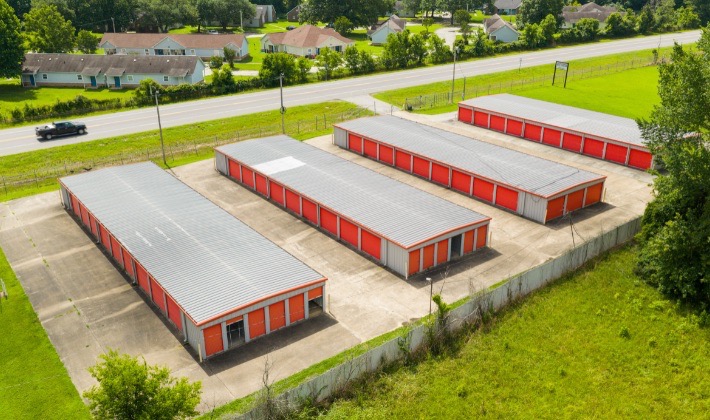
A self-storage facility isn't priced the way a house down the street is priced. Single-family real estate still moves off comparable sales, what the last few similar homes closed for nearby, which means SFR values can swing with buyer sentiment almost the way stocks do. Commercial real estate works differently. It's priced on the income it produces, divided by a cap rate. Grow the income and the value grows with it, regardless of what anyone thinks the market "feels" like this month.
None of that means real estate sits outside the economy. Interest rates set the cost of capital, and cap rates move with them, higher rates generally mean a buyer will pay less for the same income stream. A weaker economy can soften storage demand too, fewer moves, fewer businesses needing space. Those pressures are real. They're just slower and smaller than what moves a stock 3% before lunch on a headline that's wrong by 5pm.
That's the actual diversification benefit, and it's not about the label "real estate." It's about the mechanism. A well-run facility's rent roll doesn't move because the Nasdaq had a bad week. Tenants keep paying, rates keep getting reviewed, delinquent units keep getting worked, on a timeline the operator sets, not one the market sets.
It's also where private deals pull ahead of anything bought on an exchange. A public REIT still trades daily, still priced by the same crowd pricing everything else, so you inherit stock-market behavior wrapped in a real estate label. A direct stake in one asset, run by an operator making specific decisions, doesn't carry that problem. You're not betting on how the market feels about real estate as a sector. You're underwriting one facility, one business plan, one operator's ability to execute it.
That direct control means it's earned differently too, not just held differently.
None of this is an argument for pulling money out of the market. Public equities are liquid, low-cost, and easy to rebalance, three things real estate is not. They're staying in most portfolios, mine included.
The argument is narrower than "sell your stocks." It's that the diversification most people think they have isn't diversification. It's the same asset class, split a different way. Adding a fifth ETF to a portfolio that already holds four doesn't reduce correlation. It just adds false security.
Real diversification means owning something that responds to different inputs. Not a hedge against the market, a genuine second engine, one priced on rent rolls and occupancy instead of headlines and sentiment. A portfolio with both isn't hedging its bets. It's running two return streams that don't move for the same reasons at the same time.
The question worth asking isn't "should I own real estate instead of stocks." It's how much of what I already own moves together, whether I meant for it to or not.
There's no universal number for how much of a portfolio should sit outside public markets. It depends on income, time horizon, and how much illiquidity someone can actually stomach. What's consistent across the investors I talk to is that it's a slice, not a swap, usually a meaningful minority of the portfolio, not the majority.
Illiquidity is the real tradeoff here, and it deserves a clear-eyed look before committing capital. Money in a private real estate deal is typically locked in for the length of the hold, three to seven years is common. No selling next Tuesday because the news cycle got ugly, or because you've suddenly convinced yourself Tesla stock is about to take off. For some people that's uncomfortable. For others, that's the point. Not being able to panic-sell is part of why the return exists in the first place.
One practical note: a lot of this capital doesn't come from a checking account. It comes from a self-directed IRA or a Solo 401(k), retirement dollars moved out of the same public-market funds this piece has been talking about and into a private real estate position instead.
Being a passive LP doesn't automatically clear the tax picture, though. It helps avoid the "running an active business inside your IRA" version of UBIT, but if the deal uses debt financing, which most storage acquisitions do, a proportional share of the income can still trigger UDFI regardless of how passive the investor is. The specifics come down to account type, custodian rules, and how a given deal is leveraged. Worth a real conversation with a CPA before committing, not an assumption to make going in.
Self-storage isn't the only way to diversify into less volatile investments, but it's what I spend my days on, so I know it best.
Most storage facilities in the markets we target aren't run by institutions. They're run by an owner who built the thing twenty years ago and never touched the pricing again. Units are still priced at rates set before the pandemic. A large share of tenants are delinquent because no one has been chasing down the past-due accounts. There's no way to rent a unit online, no revenue management adjusting prices to demand, and no real marketing bringing in new tenants.
That's an operations gap, and we close those gaps by doing the work: fixing pricing, cutting labor by managing remotely, and running the collections process that was never run in the first place. The return doesn't depend on the facility being worth more because the storage industry got hot. It depends on that same facility generating more income than it did before, with the value following that income up.
That's the part public markets structurally can't offer. A public REIT owns hundreds of properties bundled together, and its return comes from the performance of the whole portfolio, not from any one operator fixing any one facility's problems. A direct investment in a single facility works differently. The return isn't a bet on the storage industry doing well overall. It's a bet on one operator's ability to close one specific gap.
I watched Zoom cross $400 a share in 2020, on its way to nearly $590 within weeks, then give back roughly 80% of that within two years. RingCentral did something similar, cresting above $440 and giving back closer to 90%. Neither business collapsed. The product barely changed. The price was never really about the business, it was about how everyone felt for a few months. I still hold public equities, and I plan to keep holding them. But watching that happen in real time is part of why I stopped calling a portfolio "diversified" just because it held different tickers riding the same wave.
So here's the actual question worth sitting with: how much of your portfolio moves together, whether you meant it to or not? For a lot of people, the honest answer is more of it than they'd guess.
If you're weighing what a position outside public markets might look like, I'm always glad to walk through how we do it - no pressure or pitch.
Join our investor list below and we'll keep you posted as new opportunities come up!