Investing in a private self-storage deal takes six steps:
None of it is complicated. Most people just haven't seen it laid out, so it can feel like a black box until you've done it once.
A self-storage syndication is a deal where a group of investors pools money with an operator, called the sponsor, to buy and run storage facilities. This post walks through each step the way it works at Frontier Storage Capital, in roughly the order you'd see it, though the order shifts a little depending on how you find us. We're raising capital for two facilities in southwest Arkansas right now, so the process is fresh, but nothing here depends on that deal. If you're newer to the idea, our complete guide to self-storage as a passive investment covers the bigger picture.
When you buy a stake in a business or a property deal, that stake is legally a security, and the SEC regulates how securities are sold. The core idea is protection through information. When a company sells shares to the public, it registers the offering and discloses a lot about itself, so ordinary investors can see what they're buying and the sellers can be held to what they said.
Private offerings like ours get an exemption from that full registration process. The exemption rests on a trade: lighter requirements for the seller, as long as the people investing are in a position to look after themselves. The SEC's thinking is that two things matter there. One is the ability to absorb a loss without it changing your life. The other is financial sophistication, meaning the experience to read a deal and ask the right questions. Income and net worth are the SEC's stand-in for both. It's an imperfect measure and says nothing about how smart anyone is. Plenty of sharp, careful people fall below the line, and the rules leave a door open for some who aren't wealthy, since holding a Series 7, 65, or 82 license also qualifies. The line is a practical way to decide who gets in, nothing more.
One thing worth knowing is that the SEC doesn't review or approve a deal like this. The sponsor files a notice, and that's it. The vetting is up to you, which is a big reason we want you to ask a lot of questions before you commit anything.
A 506(c) offering is a private securities offering that a sponsor can discuss publicly, as long as every investor is accredited and the sponsor verifies it. The other common path, 506(b), gives the same exemption but sets different rules for how the sponsor finds investors.
Under 506(b), a sponsor can't advertise the deal and can only approach people they already have a relationship with. Because the audience is limited that way, the sponsor can generally rely on the investor's own confirmation that they're accredited.
Under 506(c), a sponsor can talk about the offering publicly, in a blog post like this one, on LinkedIn, or in a video. Because that reaches strangers, the rule asks for more in return. Every investor has to be accredited, and the sponsor has to take reasonable steps to verify it, with documents or a third party. The reasoning is about fairness and protection. If a deal can be pitched to anyone, the safeguard is making sure only people who can afford the risk get in.
Accredited means meeting an SEC income or net worth test. As an individual, you qualify with either of these:
We raise under 506(c) because it lets us share what we're doing openly without putting the offering at risk. Under 506(b), a public post like this one could jeopardize the exemption. The tradeoff is a bit more paperwork on your side, mostly the verification step in step four.
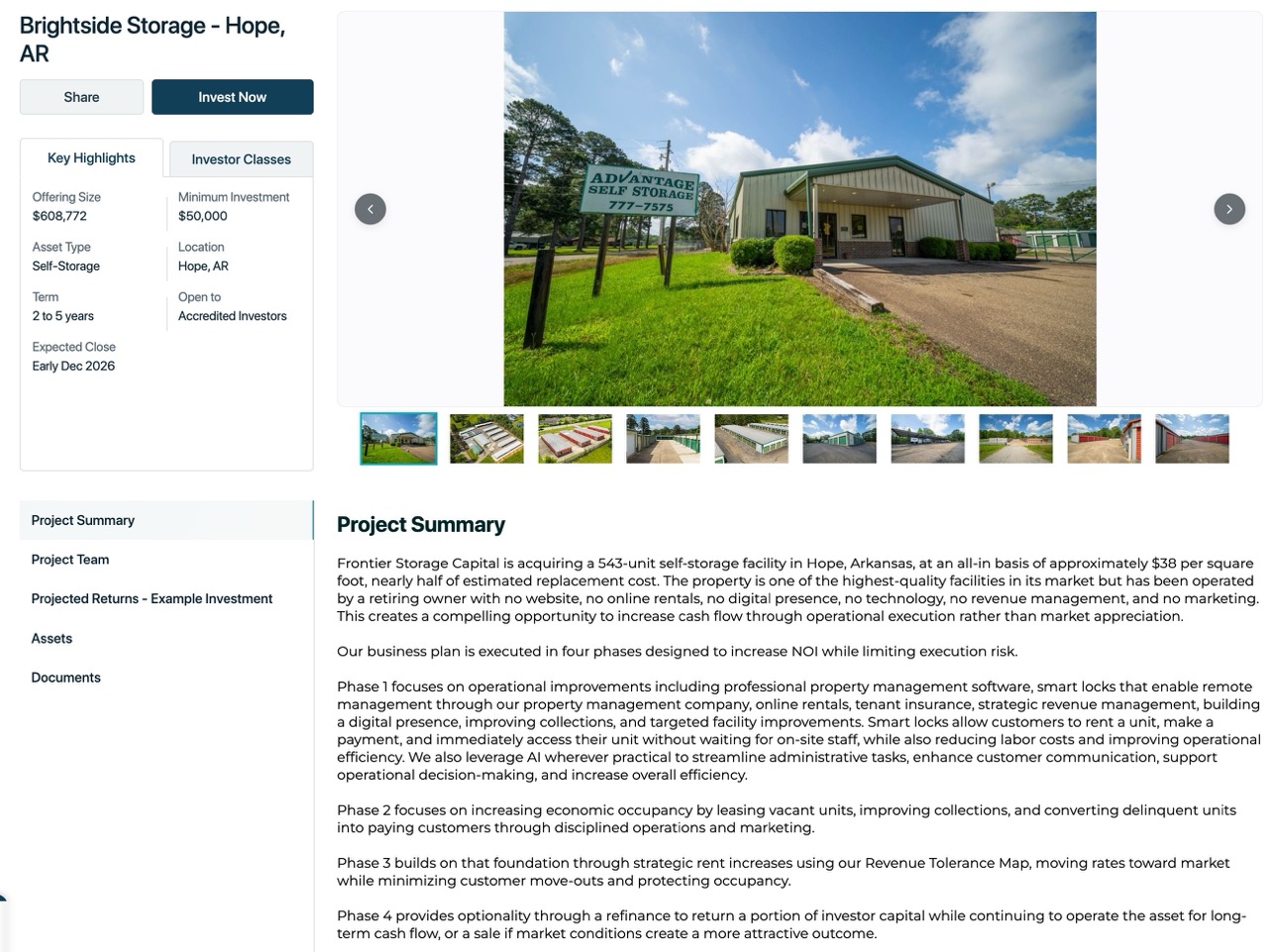
Most people start by reading about the deal. Each offering has a public page with the high-level picture: the property, the business plan, the team, and an example of how the investment structure works. You don't need an account to see it, and it's the quickest way to tell whether this is worth a conversation.
Then we talk. It's usually about 15 minutes, and most of it is us asking questions. We want to know what real estate you own now, whether you've invested in a private deal before, what check size you're comfortable with, and what matters most to you, whether that's cash flow, tax efficiency, or long-term growth. We also want to hear what would make you say no.
We're not selling on that call. If there's real overlap, we send the deck and one-pager afterward. If there isn't, we'd rather find that out in fifteen minutes than after you've filled out forms. Some people create an account first and call us after, which works fine too.
When you're ready to look closer, you can create an account on our investor portal. You can sign up from our website, or we'll send you an invitation after we've talked. Creating the account includes a short confidentiality agreement that you accept with a click. It asks you to keep what you see private, with an exception for professional counsel and your spouse.
Once you're in, you can see the offering memorandum, the financials, and the detailed specifics behind the public summary.
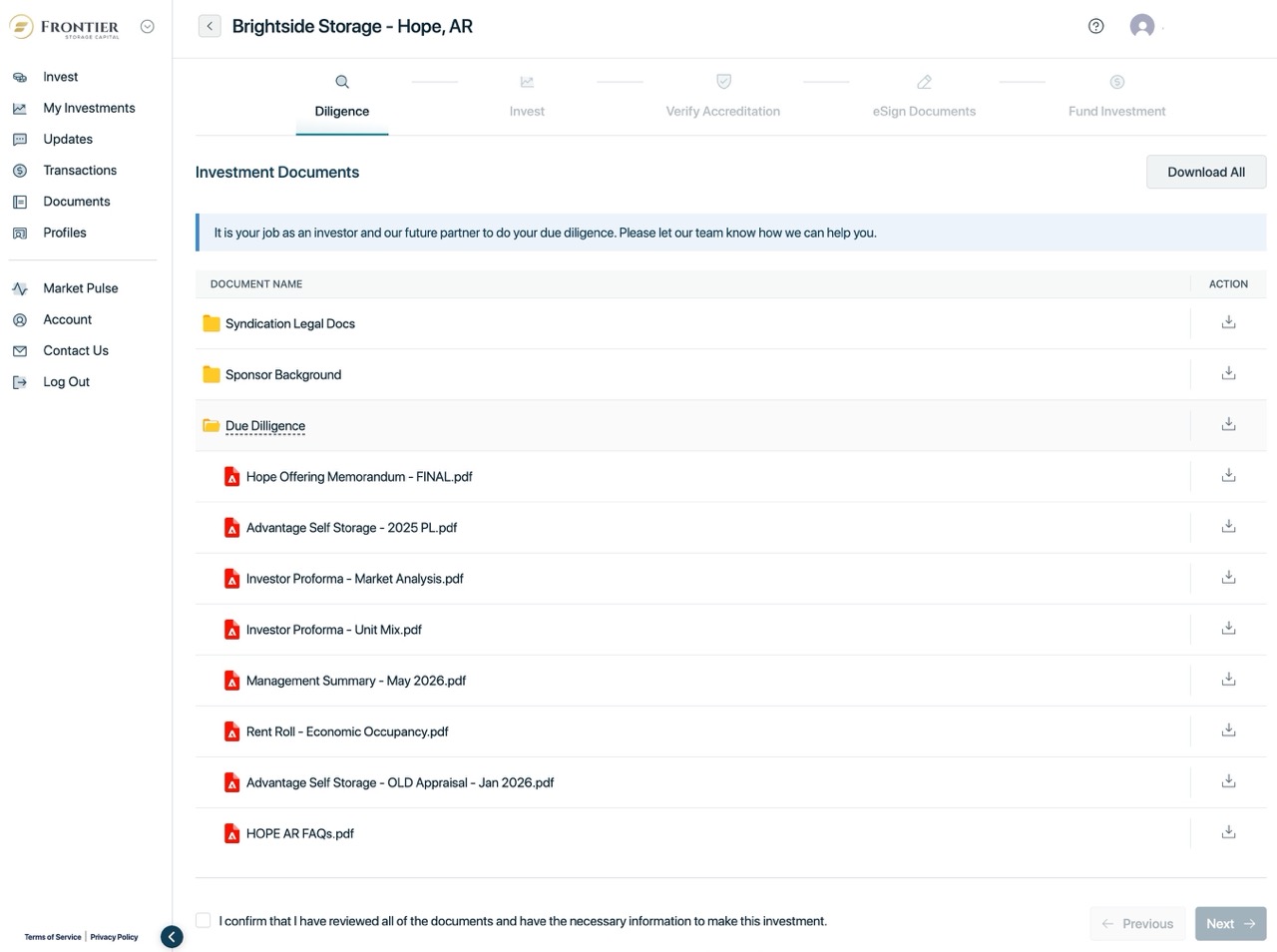
Inside the portal, you'll start on a page that lists everything in the offering: the offering memorandum, the legal documents, background on our team, and the due diligence folder. You can download all of it. The page tells you it's your job as an investor and our future partner to do your own diligence, and we mean it. If something is missing or unclear, ask us. If you want a framework for what to look for, our guide to vetting a self-storage deal as a passive investor is a good place to start.
Before you can move on, you check a box confirming you've reviewed the documents and have the information you need to make the investment. Then you choose who is investing, whether that's you personally, a joint account, an entity, or a retirement account. Each has its own profile and its own signature block. You pick the investor class, the minimum updates to match, and you enter your amount. If you work with an attorney, CPA, or financial advisor, this is the point to bring them in. We're glad to get on a call with them too.
This is the step that's different about 506(c). You have two ways through it:
Verification typically takes anywhere from a few minutes to a few days, depending on how you verify. Entities and more complex finances can take longer. Start early, because it's the step with the longest wait.
Next you sign electronically in the portal. You sign the subscription package, which is your agreement to invest, along with a W-9 for tax reporting. The version you see depends on how you're investing. Individuals and joint accounts sign one package, and entities and retirement accounts sign another, so the signature blocks are different. When I walked through it myself before sending anyone to it, the signature blocks changed depending on whether I invested personally or through an entity. If you're investing through an entity or an IRA, set that profile up in step three so the right documents show up here.
After signing, you fund. In the portal you can pay by ACH, or you can wire, and we'll send the wire instructions.
ACH is quick to start and slower to land. You confirm your identity, link your bank account, and approve the payment with a one-time code sent to your phone and email, which takes a few minutes. The money itself can take four to five business days to settle. You can follow it under Transactions, where it moves from Pending to Settled, and it shows on your bank statement as SponsorCloud, the name of the platform behind our portal. Some banks block ACH debits from a new payee by default. If yours does, call the bank and ask them to allow it, and we'll give you what they need.
Your investment then appears under My Investments as Pending. Once we've reviewed your subscription agreement and your funds arrive, it moves to Approved and you get an email.
The two longest waits are verification, which can take a few days, and the ACH transfer, which can take four to five business days to settle. Everything else moves as fast as you do. If you have a particular offering in mind, start verification early and check the closing timeline with us, so your money lands before the deal closes.
Once your investment is approved, it shows up under My Investments in the portal, alongside your documents, your transactions, and our updates. When distributions begin, they're paid quarterly. Everything is reported through the portal, including your returns, which you can always see online. We also send email updates, but the portal is the full record. Each year, you receive a K-1 for your taxes.
The steps are the easy part. The part worth your time is step three: reading the documents and deciding whether you'd still be comfortable if the plan takes longer than we expect. We'd rather you take extra time there than move fast and wonder about it later.
If you'd like to walk through the process before you start, book a call with us here. You can also look at the current offerings in our investor portal.
Disclaimer from our attorney: The information herein concerns a private placement of equity securities offered under Regulation D as promulgated by the Securities and Exchange Commission. This post is not an offer for the sale of securities. The Offering referenced herein is qualified entirely by a certain private placement memorandum circulated by the issuer of this Offering, and securities may only be offered and sold pursuant to such memorandum and applicable securities laws.